
Home »
If your product ships to customers through FedEx, UPS, USPS, or a regional parcel carrier, ISTA 3A is very likely the test your packaging needs to pass. It is one of the most requested procedures in our lab, and for good reason: no other standard test comes closer to replicating what actually happens to an individual package moving through a small-parcel delivery network.
This guide walks through what ISTA 3A covers, how the test sequence works, and what you can do before submitting samples to give your packaging the best chance of passing on the first attempt.
What Is ISTA 3A?
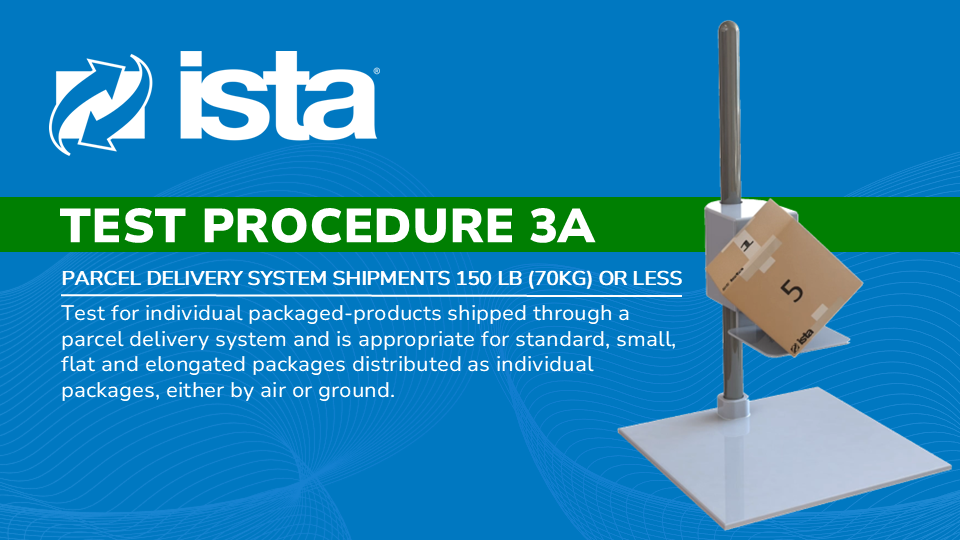
ISTA 3A is a general simulation performance test developed by the International Safe Transit Association. It applies to individual packaged products weighing 150 lbs (70 kg) or less that are prepared for shipment through a parcel delivery system.
Unlike the simpler ISTA 1 Series integrity tests, the 3 Series is designed to simulate the real distribution environment. That means the vibration profiles, drop heights, and handling sequences in ISTA 3A are modeled on data collected from actual parcel carrier networks — the sortation belts, delivery vans, and manual handling steps your package will encounter between your dock and your customer’s door.
ISTA 3A recognizes four package types, each with its own test variations:
- Standard — typical rectangular cases and boxes
- Small — compact packages below defined size thresholds
- Flat — low-profile packages like framed items or panels
- Elongated — long, narrow packages like golf clubs or rolled documents
Identifying your package type correctly matters, because it determines the exact drop orientations and test blocks your package will face.
The ISTA 3A Test Procedure, Step by Step
The full ISTA 3A testing procedure runs a packaged product through a fixed sequence of test blocks. For a standard package, the sequence looks like this:
- Atmospheric preconditioning. The package is held at ambient laboratory temperature and humidity to establish a baseline. Controlled conditioning at specific temperature and humidity combinations is available as an optional step for products sensitive to climate extremes.
- First shock test (drop sequence). The package undergoes a series of controlled drops from heights determined by its weight, striking specific corners, edges, and faces. This simulates the manual handling and sortation impacts early in the parcel journey.
- Random vibration with top load. The package rides a vibration table programmed with a random profile representing over-the-road truck transport, while carrying a top load that simulates packages stacked above it.
- Random vibration without top load. A second vibration block represents the delivery-vehicle leg of the journey, where packages typically ride without heavy stacking.
- Second shock test. A final drop sequence — including a hazard drop onto an edge — represents the last-mile handling before delivery.
The ISTA 3A drop test procedure is what most first-time clients ask about, and it is usually where marginal packaging fails. Drop heights scale with package weight, and the prescribed orientations are deliberately chosen to stress the most vulnerable corners and edges of a shipper.
ISTA 3A vs. Carrier-Specific Tests
A common question we hear: “My carrier is UPS — do I need a UPS-specific test?” UPS and FedEx both recognize ISTA 3A as the appropriate packaged-product test for their networks, which is why searches for UPS ISTA 3A test procedures lead back to the same standard. FedEx additionally maintains its own FedEx 6-A and 6-B procedures for certain shipment profiles, and Amazon requires its own ISTA 6 variants for SIOC enrollment. If you sell through multiple channels, one 3A-tested package design often satisfies several requirements at once — our team can help you map which tests your distribution channels actually require.
How ISTA 3A Fits in the ISTA System
If you are earlier in the packaging development process, a non-simulation integrity test may come first. Many clients start with ISTA 1A testing to screen early designs, then graduate to 3A for final validation. For unitized truckload shipments rather than parcels, ISTA 3E is the relevant procedure, and LTL shipments fall under ISTA 3B. Our overview of ISTA testing protocols breaks down how the full series fits together.
Preparing for ISTA 3A: What to Bring and Decide
Before you submit samples, a few decisions will save you time:
- Ship the real thing. Samples should be actual products in actual production packaging. If the product is unavailable, substitutes must match its weight, dimensions, and density.
- Define damage in advance. ISTA requires the shipper — not the lab — to determine what counts as product damage and what condition is acceptable at the end of the test.
- Over-package samples in transit to the lab. Your test samples need to arrive in untested condition, so protect them on their way to us.
- Complete the test request form. Our ISTA 3A test request form collects the product details we need to schedule and quote your project accurately.
Why Test With a Certified Third-Party Lab?
ISTA certification requires testing at an ISTA-certified laboratory, and an independent report carries weight with carriers, retailers, and insurers that in-house results cannot match. Pro-Pack Testing Laboratory has operated as an independent, third-party certified package testing laboratory since 1982, serving national clients from our facility near St. Louis. Our lab runs the complete ISTA 3 Series along with drop and impact testing, vibration, compression, and climate conditioning under one roof.
If you are ready to schedule ISTA 3A testing — or not sure whether 3A is the right procedure for your product — call us at 618-277-1160 or email support@propacktestlab.com and we will help you find the right fit.
Get Started with ProPack Test Lab:
2385 Amann Drive
Belleville, Illinois 62220
Phone: 618-277-1160
Fax: 618-277-1163